
The right coach is one search away
Search real coaches wherever they are — filter by any of 196 countries — read what their clients said, and apply from your phone. Then train from a plan written for you, by someone who can see exactly what you did. Two weeks free, then $4.99 a month, with no adverts anywhere near your measurements.


Finding a coach is the part nobody helps with
You can find a thousand workout apps and not one of them will tell you which coach is any good. So most people end up choosing from whoever happens to appear in their feed, or whoever is standing in their gym at the time.
- Search by what you actually want — speciality, language, price and rating, from 32 specialisms across 196 countries
- Nearest first — to you, or to any city or country you name
- Read the whole profile before you commit: experience, certifications, the gyms they work at, before-and-after cases and their rates
- Reviews only real clients can leave, and a coach cannot delete a bad one
- Apply from the app. No forms, no DMs, no waiting to see if someone replies to a comment
- Your coach does not have to be local. Remote coaching works properly here — they see your numbers, not your postcode
And nobody sees anything of yours until you both agree. A connection takes two yeses.
What goes wrong without it
None of these are your fault. They are what happens when the plan lives in one place and the training happens in another.
You are guessing, and you know it
A programme from the internet, written for nobody in particular, with no way of telling whether it suits you.
You cannot remember what you lifted last time
So you use the same weight you have used for a month, or guess and go too heavy.
Everything lives in a chat thread
The plan, the session times, the advice — agreed on Tuesday and buried by Thursday.
The scale has not moved, so you assume it is not working
Six weeks in, the number is the same, and you start wondering why you bother.
Your first week
From installing the app to finishing a session.
- 1
Create an account and start your two weeks free
Then add your height, gender and training goal in your profile — height and gender shape your body figure and the body-fat estimate, and the goal tells a coach what to programme for.
- 2
Find a coach, or bring your own
Search and apply, or accept an invitation from the coach you already train with. Both sides have to agree, and nothing of yours is shared until you do.
- 3
Take your first measurements
Optional, but this is the baseline everything later is compared against. Weight and a waist measurement alone are enough to start.
- 4
Train
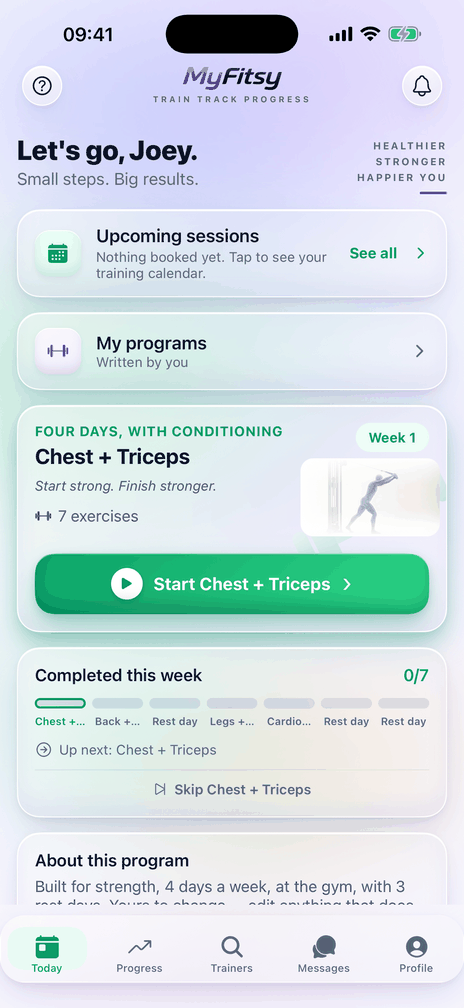
Today shows the session. Log what you lift. Finish the workout.
- 5
Look again in three weeks
One session tells you nothing. Three weeks of logged weights and two sets of measurements tell you whether the plan is working.
A session, start to finish
- Today tells you one thing: the workout you are meant to do, and nothing else competing for the space
- It knows which day you are on. Miss a week and it resumes where you stopped — no streak, no penalty, nothing to reset
- Every exercise arrives with its target and with what you did last time, so progression is a comparison rather than a memory test
- Supersets run as one — straight from one exercise to the next, with the rest after the round
- Tap an exercise and watch it done — 412 movements in the library carry a short animation, so “Romanian deadlift” is something you can see rather than a name you have to look up somewhere else
- Weights, bodyweight or cardio — a pull-up and a 5 km run both log properly, not as a lift with empty boxes
- Two timers, because sets and sessions are different things — rest counts down from whatever the exercise says, and a stopwatch counts up whenever you want to time something yourself
- Skip a day on purpose if life happens, and the plan moves on instead of getting stuck
- Finished early in the week? Start the next session straight away rather than waiting for tomorrow
Everything you log is kept. Your history is a list of dates — tap one and see that session exactly as you recorded it, however long ago. Deleting a programme never deletes the workouts logged on it.
Today
Progress, when the scale will not cooperate
Progress
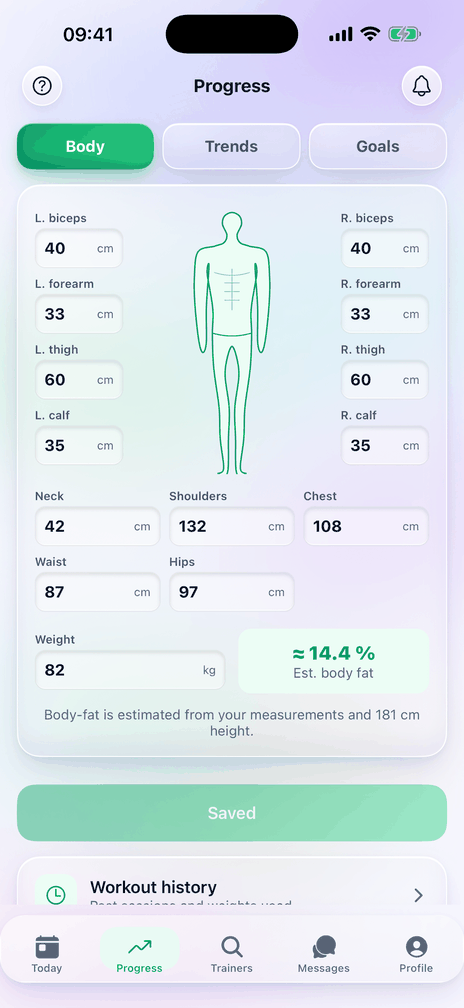
- Fifteen measurements, not one. Weight, a body-fat estimate and 13 circumference sites
- This is how you see recomposition the scale hides — losing fat and gaining muscle can leave your weight untouched for weeks
- Watch your body change. Your figure, with each number on the muscle it measures — slide back to your first measurement and see how far each one has moved
- Charts tell you how fast, not just how much: “0.4 kg per week” answers the question you actually have
- Goals for one measurement or your whole body, with a date, updating themselves from what you log — and shareable if public commitment helps
- Kilograms or pounds, centimetres or inches — one switch, and everything follows it
What gets measured
Neck, shoulders, chest, waist, hips, both arms, both forearms, both thighs and both calves, plus weight and the estimated body-fat percentage. Blanks are fine — record what you have. Ranges run from one week to all time.
The body-fat figure is an estimate from your measurements, height and gender, not a clinical reading. Use the trend, ignore the decimal place, and measure the same way each time.
You do not need a coach to start
Most people arrive without one. That is normal, and the app does not sulk about it.
- Answer four questions and have one written for you — your goal, where you train, roughly how experienced you are, and how many days a week. You get a full programme, and every day of it is yours to change
- Or write your own — up to ten of them, with the same builder a coach uses, picking exercises from the same library of 412, and run whichever one you are on
- They appear on Today exactly like a coach's would, and log into the same history
- They stay yours. A coach you train with can read them, so a session you log against one makes sense to them — but cannot edit, assign or delete them
- Measurements, trends and goals all work with nobody else involved
Then, when you want someone to take it further, the coach is a search away — and you arrive with months of real training history rather than a conversation about what you think you have been doing.
Prefer to train from a page instead? Our workout programmes are free to read and follow with no app at all — full session tables, weekly volume and progression rules.
Knowing when you train
- Sessions appear when your coach books them, with the note they wrote — “assessment”, “deadlift technique” — so you know what you are turning up for
- One calendar for both: sessions with your coach and the workouts you have completed, in different colours
- You are told when something moves or is cancelled, rather than finding out at the gym
- Message your coach where the training is, one to one or in a room they put together, with photos and video when a form check needs showing rather than describing
What your coach can and cannot see
Enforced in the database, not by the app hiding buttons.
| You | Your coach | Anyone else | |
|---|---|---|---|
| Your measurements and body-fat estimate | ✓ | ✓ | — |
| Your logged workouts and skipped days | ✓ | ✓ | — |
| Your goals | ✓ | — | — |
| Programmes you wrote for yourself | ✓ | ✓ to read | — |
| Your messages with them | ✓ | ✓ | — |
| Your messages with a different coach | ✓ | — | — |
| Your booked sessions | ✓ | ✓ | — |
| Who else is in your group session | — | ✓ | — |
| Editing anything you logged | — | — | — |
That is while you train together. When coaching ends, your former coach keeps your measurements and workouts up to that day and sees nothing newer, and no longer sees your profile or the programmes you wrote. While a request is waiting or has been declined, a coach sees nothing of yours. Your history, measurements and goals stay in your account, because they are yours. If anyone behaves badly you can report them from their profile — or block them, which stops the contact immediately, removes even what they had, and does not tell them.
Why not just use a free workout tracker?
A fair question, and for some people the answer is that you should.
| Generic tracker app | MyFitsy | |
|---|---|---|
| Log your lifts | ✓ | ✓ |
| See last session's weights | ✓ | ✓ |
| Charts | ✓ | ✓ |
| Write your own programmes | ✓ | ✓ |
| Find a coach | — | ✓ |
| A plan written for you specifically | — | ✓ |
| Your coach can see what you actually did | — | ✓ |
| Your coach can adjust the plan because of it | — | ✓ |
| Session times with your coach | — | ✓ |
| Body measurements beyond weight | Sometimes | ✓ 13 sites |
| Message your coach in the same app | — | ✓ |
If you train alone and know exactly what you are doing, a generic tracker will serve you. The moment a coach is involved, the difference is that they can see the log — and everything about coaching improves when the person writing the plan can see what happened to it.
What it costs
Two weeks free
The whole app, with nothing withheld — coach search included. Start it from the app; nothing is charged until the fortnight is up.
$4.99 a month after that
Billed by Apple or Google, cancel from your phone at any time. The exact figure shown at checkout varies slightly by country with local tax.
What you pay your coach is separate
That is between the two of you. MyFitsy does not handle it and takes no commission, so none of your fee goes anywhere but to them.
Your records survive a pause
Stop subscribing and nothing is deleted. Measurements, history and goals stay readable, and pick up where they left off when you come back.
Full detail on Pricing.
Questions clients ask
How do I find a coach?
What does it cost?
Can I use it without a coach?
Do I need my coach to use MyFitsy too?
Can I have more than one coach?
What happens if I stop working with my coach?
What happens to my workouts if a programme is deleted?
Can I reconnect with a coach later?
What if I miss two weeks?
Do I have to enter measurements?
How accurate is the body-fat number?
Can my coach change my logged weights?
Can I use pounds and inches?
Will other people in my group session see my data?
How do I delete my account?
Which phones does it work on?
Find a coach, or start on your own
Two weeks free. Cancel before they are up and you pay nothing.